
FIRM ARCHITECTURE
YOUR BUSINESS IS GROWING.
WHY DOES IT FEEL HARDER TO RUN?
Revenue is higher. Your team is bigger. You have more tools, more data, and more processes.
Yet more decisions end up on your desk. More problems require your attention. And despite all the growth, the business doesn't feel easier to run.
The business is bigger. But is it actually better?
Yet more decisions end up on your desk. More problems require your attention. And despite all the growth, the business doesn't feel easier to run.
The business is bigger. But is it actually better?
MAYBE THE PROBLEM DOESN'T LOOK LIKE A PROBLEM YET.
Monday. Three people need a decision only you can make.
Tuesday. Two departments disagree about who owns a problem.
Wednesday. A process that was supposedly standardized still depends on one particular employee.
Thursday. Someone proposes another software tool to fix a workflow that already involves five tools.
Friday. Sales look strong. But the bank account tells a different story.
The month ends. Revenue is up. Headcount is up. Software costs are up. Management time is up.
But is the business actually getting better?
Your team keeps growing. Your calendar doesn't get any lighter.
You delegate tasks. But the decisions keep coming back to you.
Projects move slowly, even when everyone seems busy.
Departments hit their individual targets while creating problems for each other.
You have more data than ever, but not necessarily better decisions.
Your best employees become indispensable — and that becomes a risk.
The same categories of problems keep returning, no matter how many times you solve them.
And the more successful the company becomes, the harder it is to imagine it running without you.Headcount is up. Software costs are up. Management time is up.
But is the business actually getting better?
When sales slow down, you push the sales team harder.
When marketing underperforms, you change the strategy.
When a department struggles, you hire a better manager.
When reporting becomes unclear, you introduce another dashboard.
When decisions take too long, you schedule another meeting.
When people are overloaded, you hire more people.
When communication breaks down, you introduce another tool.
When margins tighten, you cut costs.
When cash becomes a problem, you push for more revenue.
Each response makes sense on its own.
But what if these aren't nine separate problems?
What if they are nine different outputs of the same underlying system?
THE NUMBERS SHOW THE RESULT.
THEY DON'T ALWAYS SHOW THE SYSTEM PRODUCING IT.
Your P&L shows your margins. It doesn't show the thousands of organizational decisions quietly compressing them.
Your cash-flow statement shows financial pressure. It doesn't show the dependencies, delays, and incentives creating that pressure.
Your headcount tells you how many people you employ. It doesn't tell you whether you've increased productive capacity or simply added another layer of coordination.
Your dashboards show performance. They don't necessarily explain why important information reaches the wrong person, too late.
Your organizational chart shows reporting lines. It doesn't reveal who actually makes decisions, who waits for approval, or where authority breaks down.
And your revenue tells you how much your business has grown. It doesn't tell you whether the organization has become stronger — or simply larger.
Financial performance is evidence.
To understand the evidence, you have to examine the organization producing it.
YOU ALREADY HAVE AN OPERATING SYSTEM.
YOU JUST MAY NEVER HAVE DESIGNED IT.
Every business operates according to a system of rules.
Some are written down. Most aren't.
Who can make a decision without asking permission.
Which problems get escalated — and which get ignored.
What information reaches management, and when.
Which numbers departments are rewarded for improving, even when those improvements hurt the business as a whole.
Which exceptions become normal.
Which employees everyone depends on.
And which decisions eventually find their way back to the CEO.
These rules didn't necessarily emerge from a deliberate plan.
They developed one hire, one crisis, one new tool, one workaround, and one "just send it to me" at a time.
Over the years, those thousands of small decisions became the architecture of your organization.
And that architecture is producing the results you see today.
EVERY ORGANIZATION IS PERFECTLY DESIGNED TO PRODUCE ITS CURRENT RESULTS.
STOP SEEING ISOLATED PROBLEMS.
START SEEING THE ARCHITECTURE CONNECTING THEM.
Instead of asking:
"Why can't my managers take more responsibility?"
Ask:
"How have we designed authority, information, and consequences — and are we making responsibility possible?"
Instead of asking:
"Do we need to hire more people?"
Ask:
"Are we facing a genuine capacity constraint, or have we created unnecessary coordination?"
Instead of asking:
"Why does everything still come back to me?"
Ask:
"What mechanisms keep pulling decisions upward?"
Instead of asking:
"Why isn't revenue growth improving our cash position?"
Ask:
"What happens between generating revenue and creating economic value?"
Instead of asking:
"Which department is underperforming?"
Ask:
"Where is local optimization damaging the performance of the organization as a whole?"
THIS BOOK IS DESIGNED TO CHANGE THE WAY YOU SEE YOUR BUSINESS.
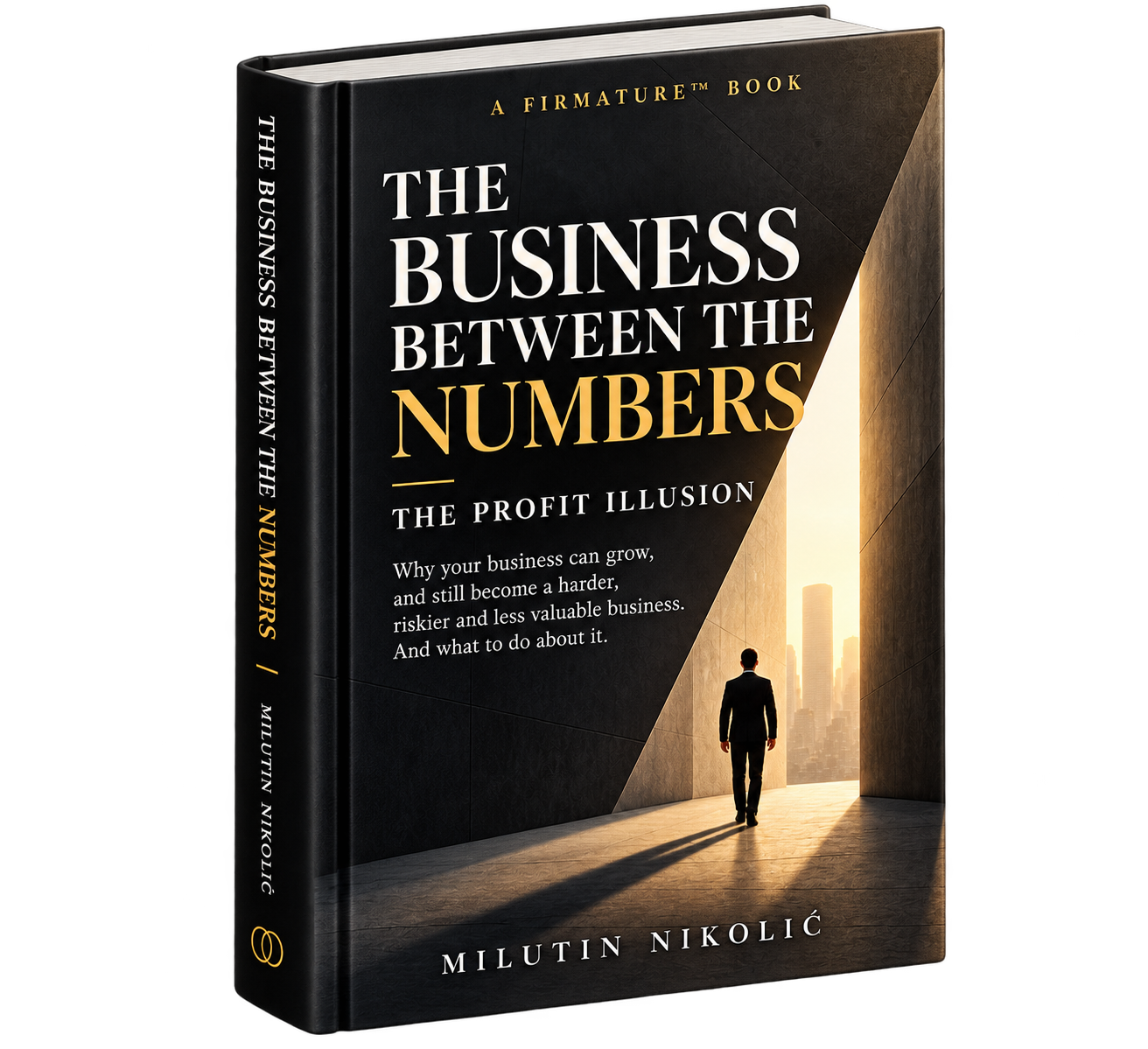
The Business Between the Numbers — The Profit Illusion is not another collection of management tactics.
It is a different way to understand why your company produces the results it does.
Instead of treating every recurring problem as an isolated failure of people, processes, or performance, the book helps you examine the organizational architecture connecting them.
You'll begin to recognize the difference between a performance problem and a design problem.
You'll see why delegating tasks doesn't necessarily mean delegating decisions.
Why hiring more people can sometimes increase complexity faster than capacity.
Why your most valuable employees can quietly become your greatest operational dependencies.
Why departments can meet their targets while the company as a whole becomes less effective.
Why more information doesn't automatically produce better decisions.
And why a growing business can become harder to manage, less resilient, and less valuable — even while its financial results appear to improve.
The objective is not to give you another list of things to do.
It is to give you a better way to see the business you're already running.
THE FIRMATURE LENS
Organizational Gravity™
Why decisions, responsibility, and attention keep moving back toward the CEO — even after you've delegated them.
Decision Distance™
What happens when the people making decisions are too far removed from the information, consequences, or reality of those decisions.
Executive Attention™
Why your attention is one of the company's most limited resources — and how the organization consumes it.
Organizational Complexity
How additional people, processes, tools, and management layers can quietly consume the value that growth creates.
Profit Architecture™
How the design of your organization influences margins, cash flow, productive capacity, resilience, and long-term business value.
These aren't abstract theories to memorize.
They're a vocabulary for patterns you may already be experiencing — but haven't been able to see clearly or connect.
WHAT YOU'LL DISCOVER INSIDE THE BOOK
INSIGHT DOESN'T CHANGE AN ORGANIZATION. ACTION DOES.
Reading a book can change how you see your business. But understanding the problem is only the beginning.
The Firmature™ Executive Sprint™ is a structured 30-day companion designed to help you apply the ideas from The Business Between the Numbers to your own organization.
Through focused executive missions, you'll examine how decisions are made, where complexity accumulates, why responsibilities keep returning to you, and which operating rules may need to change.
Not another productivity challenge. A practical starting point for redesigning how your business operates.
WHAT YOU'LL WORK ON DURING THE 30-DAY SPRINT

You won't transform your entire company in 30 days. But you can begin to understand the system that's running it — and start designing a better one.
TWO RESOURCES. ONE BETTER WAY TO RUN YOUR BUSINESS.
The Firmature™ Launch Edition brings together two complementary resources: a book that changes how you understand your business, and a practical 30-day executive companion that helps you put those insights to work.
Read the system. Examine your own. Start changing what matters.
Read the system. Examine your own. Start changing what matters.
Launch Edition — $39
YOUR LAUNCH EDITION INCLUDES:
✓ The Business Between the Numbers — The Profit Illusion
✓ Firmature™ Executive Sprint™ — 30-Day Implementation Companion
✓ Structured executive missions and practical organizational exercises
✓ A framework for identifying bottlenecks, dependencies, and decision-making problems
✓ Instant digital access to both publications
BUILT FOR THE CEO WHO KNOWS SOMETHING NEEDS TO CHANGE.
You've built a real business. Customers buy. Revenue comes in. People depend on the company you've created.
But somewhere along the way, growth started creating problems instead of solving them.
You're involved in decisions your team should be able to make. Departments are busy, yet progress feels slower. You're hiring people, adding systems, and introducing processes — but the business still depends too heavily on you.
Firmature™ is for founders, owners, and CEOs who are ready to stop treating these problems as isolated incidents — and start examining the organizational system behind them.
THIS MAY SOUND FAMILIAR.
✦ Decisions you've delegated somehow keep returning to your desk.
✦ Your calendar is full of meetings, but the same problems keep resurfacing.
✦ Revenue is growing, yet margins and cash flow remain under pressure.
✦ Every new hire seems to create another layer of coordination.
✦ Your managers are busy, but accountability still feels unclear.
✦ Taking a week away from the business feels more stressful than staying.
If these problems sound familiar, the answer may not be to work harder, hire faster, or add another tool.
It may be time to examine the system your business has become.
It may be time to examine the system your business has become.
BUILT FROM EXPERIENCE. NOT JUST THEORY.

Milutin Nikolić — Founder of Firmature™
I've spent years building, operating, and growing digital businesses.
As a co-founder and business operator, I've helped build ventures that generated more than $10 million in sales and served over 500,000 customers. My work has involved everything from customer acquisition and conversion optimization to product development, operations, and long-term profitability.
But building a growing business teaches you something that revenue reports rarely reveal: growth creates its own problems.
More customers require more systems. More people create more decisions. More processes introduce more dependencies. And unless the organization evolves deliberately, the founder can become the bottleneck of the very business they built.
Firmature™ grew from a simple question:
What if the real challenge isn't growing a business — but designing one that becomes stronger as it grows?
The Business Between the Numbers explores that question. The Executive Sprint™ helps you begin applying its ideas to your own organization.
FREQUENTLY ASKED QUESTIONS
The Firmature™ Launch Edition includes two digital publications: The Business Between the Numbers — The Profit Illusion and Firmature™ Executive Sprint™, a structured 30-day implementation companion with practical executive missions and organizational exercises. Both are included in the one-time price of €39.
Both publications are delivered digitally. There are no physical books or shipping costs. You'll receive access to the materials after completing your purchase.
No. The Executive Sprint™ is structured as a 30-day experience, but you can work through the missions at your own pace. The goal is to examine your organization thoughtfully, not to rush through a checklist.
Yes. Firmature™ is designed for founders, business owners, and CEOs who are managing growing organizational complexity. You don't need a large company to benefit, but the material will be most relevant if your business already has customers, recurring operations, and decisions that involve other people.
No. Meaningful organizational change takes time. The Executive Sprint™ helps you identify how your business operates, recognize structural problems, and develop a practical starting point for improvement. It is a diagnostic and implementation-planning process, not a promise of instant transformation.
Your purchase is covered by a 60-day money-back guarantee. You can request a refund within 60 days of payment, subject to the refund policy shown at checkout.
YOUR BUSINESS DOESN'T NEED MORE COMPLEXITY. IT NEEDS A BETTER SYSTEM.
You've already built something worth protecting. Now it's time to understand the system behind it — and begin making it stronger.
Get The Business Between the Numbers and the Firmature™ Executive Sprint™ together in one practical digital package.
Get The Business Between the Numbers and the Firmature™ Executive Sprint™ together in one practical digital package.
60-Day Money-Back Guarantee · Secure Checkout · Instant Digital Access
FIRMATURE™
FIRM ARCHITECTURE
A methodology developed and published by Big Web Profits d.o.o.
© 2026 Firmature™. All rights reserved.
© 2026 Firmature™. All rights reserved.